

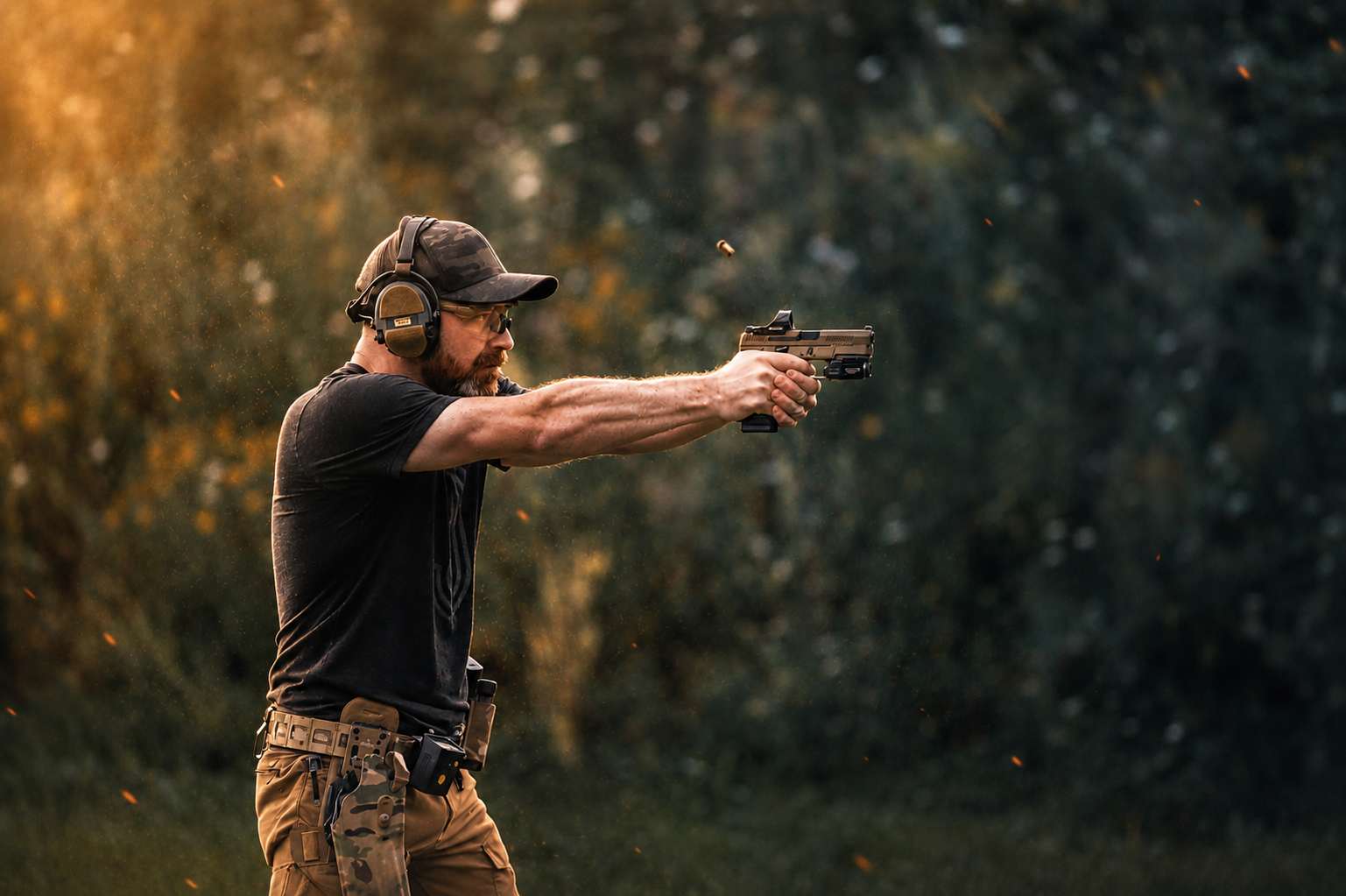
Walk onto most ranges and you will see the same picture: a line of shooters sending rounds downrange, a target that rewards a good day, and an unspoken belief that enough repetition will eventually make someone good. It is comfortable, it is familiar, and it is mostly wrong. Volume without structure builds habits — it just does not care whether those habits are the right ones. You can spend years and thousands of rounds reinforcing a flinch, a bad grip, or a trigger press that only works when nothing is on the line.
Black Watch was built to reject that model. We treat shooting the way a serious discipline deserves to be treated — as a craft. Not a talent you are born with, not a hobby you dabble in, but a skill you build deliberately, in the right order, with feedback that tells you the truth. That single shift in philosophy changes everything downstream: what we teach first, how we structure a course, how we measure progress, and what we are willing to call mastery.
Tradition Is Not a Training Method
The shooting world runs on inherited wisdom. A technique gets passed down because an instructor learned it from someone they respected, who learned it from someone they respected, and somewhere back up the chain it may have been the right answer for a different gun, a different mission, or a different era. Tradition has value — it carries hard-won lessons — but tradition is not the same thing as a method. A method can tell you why a technique works, under what conditions it holds up, and how to know when a student has actually acquired it.
We are not interested in repetition for its own sake, and we are not interested in mystique. We are interested in what reliably produces a shooter who performs the same on the move, under load, and on a bad day as they do on a calm morning at the range. That question — what actually transfers — is a science question, not a tradition question. So we answer it with science.
Performance Science and Motor Learning
Every Black Watch course is grounded in motor-learning research and performance science. That is not a marketing line; it dictates the structure of the training day. Motor learning is the study of how humans acquire, retain, and refine physical skill — and it has decades of evidence about what builds durable performance versus what produces a temporary, range-only competence that evaporates the moment conditions change.
A few principles do most of the heavy lifting. Skill is built in a sequence. You install clean mechanics under low complexity before you add speed, movement, and decision-making — because trying to learn the foundation and the chaos at the same time produces neither. Feedback has to be specific and timely. A shooter who is told exactly what their grip or trigger did, while the rep is still fresh, learns faster than a shooter left to guess. Stress has to be dosed, not dumped. Pressure is the tool that makes a skill transfer to the real world, but applied too early or too heavily it just reinforces breakdown. And measurement is non-negotiable — if you cannot put a number on it, you cannot tell improvement from a good day.
We didn’t invent pistolcraft or riflecraft. What we bring is how it’s taught — performance science and motor-learning research, not tradition or volume for its own sake.
Install, Pressure-Test, Prove It Transfers
Those principles collapse into a simple, repeatable arc that runs through everything we do. Install the correct mechanics through deliberate, closed-skill repetition — grip, stance, sight picture, trigger, the draw — until they run without conscious thought. Pressure-test them with measured stress: par times, performance metrics, instructor-designed problem sets that raise the difficulty in a controlled way. Then prove they transfer off the square range — on the move, from awkward positions, under time, in scenarios that demand a decision before they demand a shot.
This is why a Black Watch course does not feel like a day of standing on a line burning ammunition. The first day of a course tends to be quiet, technical, and demanding in a way that has nothing to do with intensity for its own sake — it is where the motor program gets built clean. The second day is where pace and pressure get layered on and the skill gets tested against a standard. The structure is intentional, and it is the same logic whether you are running a pistol or a carbine.
Marksmanship and Manipulation Become Automatic
The goal of installing mechanics correctly is automaticity — the point at which marksmanship and weapon manipulation no longer require your attention. This matters far more than it sounds. Attention is a finite resource. Every scrap of it you spend remembering how to grip the gun, find the sights, or run a reload is attention you do not have for the actual problem: reading the situation, moving, making a lawful and sound decision under stress.
When the mechanics are automatic, the shooter is freed up to think. That is the entire point. We are not building people who can shoot a clean group in ideal conditions; that is the floor, not the ceiling. We are building people whose hands handle the gun so the mind can handle the fight — or the match, or the high-stakes moment — that the gun is only one part of.
Measured Against a Standard, Not a Vibe
Because we measure, progress at Black Watch is honest. You are not graded on enthusiasm or on how the day felt. Core Skills culminates in a timed standard. Dynamic Performance holds you to par times and metrics. Defensive Application debriefs against benchmarks. And the entire progression points at a mastery standard — the Artifex Capstone — that is earned in front of a review board, not handed out for showing up.
That accountability is a feature, not a hazing ritual. A standard tells you the truth about where you are, gives you a clear target to build toward, and means that when you do reach it, it is worth something. A certificate that everyone gets is a participation trophy. A standard that has to be met is a craft.
The Role of the Instructor
A method is only as good as the feedback that delivers it, and this is where a craft approach quietly separates itself from a volume approach. On a typical range, the instructor is a safety officer and a cheerleader — there to keep the line safe and to tell you “good hits.” That is not coaching; it is supervision. In a craft, the instructor is a diagnostician. Their job is to watch a repetition, see precisely what your grip, your trigger, or your draw actually did, and give you a specific correction while the rep is still fresh enough to change.
That is demanding work, and it is why our standards for instructors are as deliberate as our standards for students. We invest in instructor development as its own off-path discipline — by request, for those who want to learn to teach the method rather than simply perform it — because a coach who can only shoot well is not the same as a coach who can build the skill in someone else. The two are different crafts, and the second is the one that makes a training organization worth anything.
Two Days That Don’t Feel Like the Range You Know
Put all of this together and a Black Watch course does not resemble the range day most shooters picture. Day one of a course is often quieter and more technical than people expect — fewer rounds fired with more attention paid to each, because that is how a clean motor program gets installed. It can feel slow if you came in expecting volume. It is not slow; it is precise, and the payoff arrives on day two, when pace and pressure get added and you discover the mechanics hold because they were built right.
By the end you do not just have a fun day behind you and some brass on the ground. You have a measured baseline, a clear picture of what your shooting actually does under a standard, and reps you can keep building on long after the course ends. That durability — skill that is still there next month, not just on the drive home — is the whole return on training as a craft.
What This Means for You
If you have never fired a gun, the craft approach means you will be built correctly from the first repetition — no bad habits to unlearn later, a clean foundation that everything else stacks onto. If you have shot for years, it means you will finally get specific, measured feedback on what your fundamentals are actually doing, and a path to rebuild the pieces that years of unstructured volume quietly bent out of shape. The method meets you where you are and pushes real development from there. That is true at every level, which is the whole idea.
Shooting is not a talent you either have or you do not. It is a craft. Treat it like one — build it deliberately, test it honestly, and prove it transfers — and the results stop depending on luck. That is the Black Watch method, and it runs through every course we teach.
Vsqve ad extremvm spiritvm mevm — to my last breath. The standard does not move.
Ready to build the foundation the right way? Explore the Black Watch course path, check the training calendar for the next open class, or reach us at [email protected].
Leave a Reply