

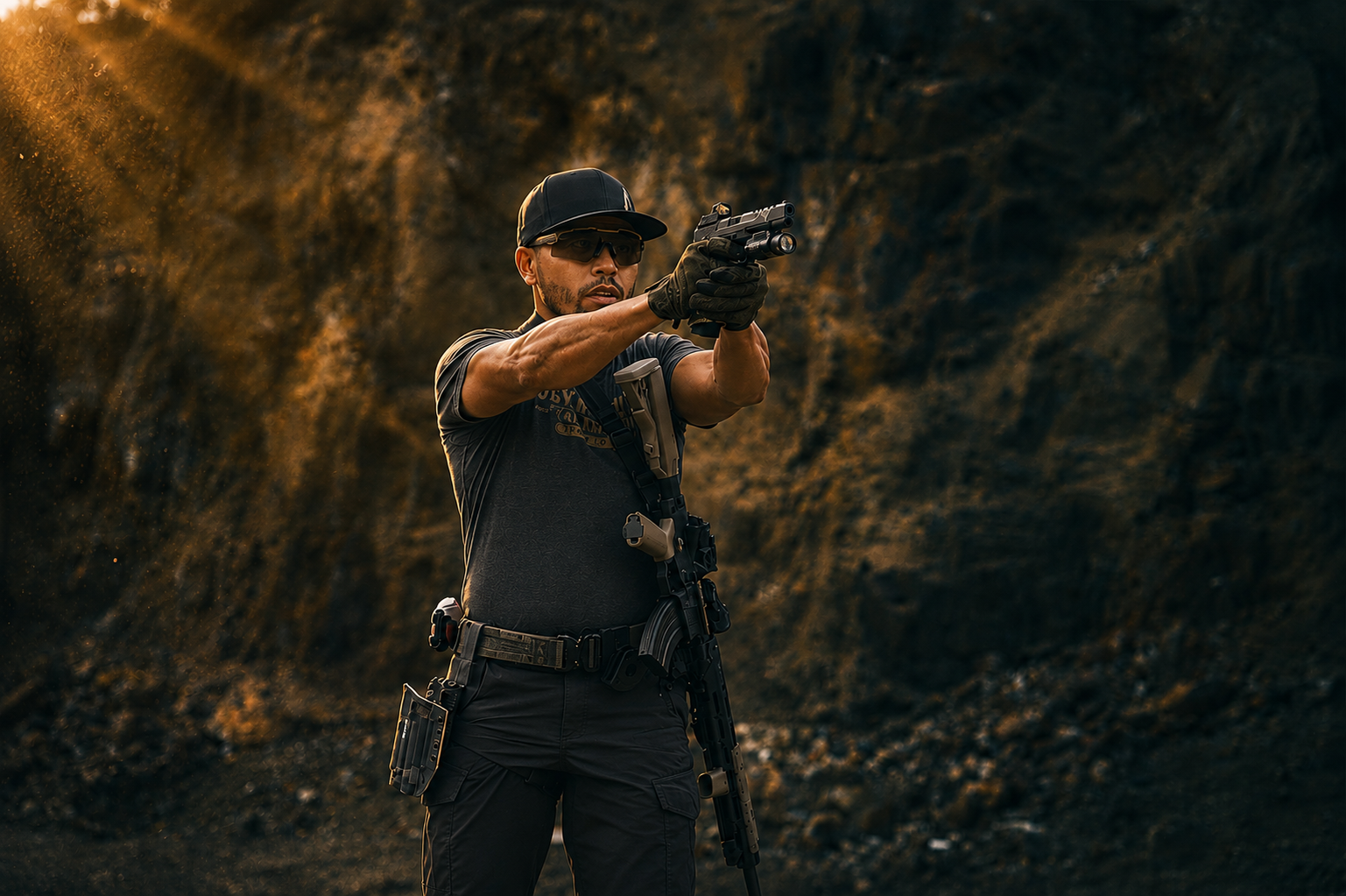
At Black Watch, the gun you train on is your platform — pistol or carbine. The way we approach each one has a name: Pistolcraft for the handgun, Riflecraft for the carbine. These are not courses and they are not marketing labels; they are the two disciplines our entire program is organized around. Understanding what each one is — and what they share — explains how the whole system fits together.
A quick note on language, because words matter to us. Pistolcraft and Riflecraft are training-approach terms, not class names. “Riflecraft” is also the word we now use in place of the older “Rifle Work.” And while the same three-step course path runs through both, each discipline has its own texture, its own gear, and its own demands. Here is how they break down.
What Pistolcraft Is
Pistolcraft is the systematic skill of using a handgun for defensive, tactical, and competitive purposes — far more than aiming and firing on a static range. The discipline spans marksmanship, weapon manipulation by feel, movement, use of cover, low-light work, and the mindset and decision-making that govern when and whether to act. It is the through-line that connects a clean first shot to a sound decision under stress.
The modern, two-handed, dynamic technique at the heart of pistolcraft was pioneered by Jeff Cooper and the institutions that followed him — we did not invent it, and we are honest about that. The handgun is the platform most people carry and most likely to be in hand in a defensive moment, which puts a premium on the things pistolcraft trains hardest: drawing from concealment, manipulating the gun without looking at it, and making fast, lawful decisions in close, ambiguous situations.
What Riflecraft Is
Riflecraft is the comprehensive skill of running a rifle — again, far more than hitting a target on a flat range. The discipline blends marksmanship, a stable and repeatable firing platform from any position, an understanding of optics and zero, and the weapon-handling to keep the gun running under stress. It is the through-line that connects a confirmed zero to a fast, sensible, accurate shot when the situation is not ideal.
Riflecraft has deep roots — in military marksmanship and decades of hard-won practical experience. The carbine rewards different things than the handgun: building a stable platform fast from awkward positions, managing a longer weapon through movement and cover, and understanding how your optic and zero behave at varying distances. Where pistolcraft lives in the close and the concealed, riflecraft extends the problem out and adds the demands of a shoulder-fired weapon.
Pistolcraft is the discipline. Riflecraft is the discipline. Performance science is how we teach both.
Different Platforms, the Same Method
Here is what unifies them. We did not invent pistolcraft or riflecraft — both are established disciplines with their own histories. What Black Watch brings is how they are taught: through performance science and motor-learning research, not tradition or volume for its own sake. That method is identical across platforms, even though the specific skills differ.
In both disciplines, every element is built deliberately and in order. Install correct mechanics. Pressure-test them with measured stress. Prove they transfer off the range. Marksmanship and manipulation become automatic first; movement, cover, positional work, and low-light get layered on once the foundation holds; mindset and lawful decision-making run through all of it. The result, on either platform, is a shooter who does not just perform on a good day on a square range — but holds the same standard on the move, under load, and when it actually counts.
One Path Through Both
Because the method is shared, the course path is too. Each discipline runs through the same three tiers:
- Core Skills — marksmanship and weapon manipulation by feel (and, on the carbine, zero), built into automatic, repeatable mechanics. The foundation everything else is layered on.
- Dynamic Performance — speed, movement, and target transitions under measured stress; getting off the X and shooting on the move, or building a stable carbine platform fast.
- Defensive Application — working from cover and unconventional positions, low-light, force-on-force, and lawful decision-making under pressure.
Master the full path on a platform and it culminates in the Artifex Capstone for that platform — prove the standard to earn your Artifex Patch and Coin for the pistol or the carbine. The progression, the prerequisites, and the standards mirror each other across both disciplines, which is exactly why a shooter can pursue one, the other, or both with a consistent framework underneath them.
Why “Platform,” Not Caliber or Brand
You will notice we organize everything around platform — pistol or carbine — rather than around caliber, brand, or a specific model. That is deliberate, and it follows directly from the craft approach. The discipline is in the skill, not in the equipment. Pistolcraft is the same discipline whether you run a striker-fired nine or something else entirely; riflecraft is the same discipline across the common carbine variants. The mechanics, the manipulation by feel, the positional work, and the decision-making transfer across guns within a platform because they were built as skills, not as muscle memory tied to one piece of gear.
This matters for how you should think about your own training. Chasing the next piece of equipment is the most common way shooters avoid doing the actual work — a new optic or holster feels like progress without demanding any. The platform framing keeps the focus where the craft lives: on what your hands and your judgment can do, on any gun of that type, under a standard. Gear serves the skill. It does not substitute for it.
The Demands Are Different – On Purpose
While the method is shared, we do not pretend the two platforms are interchangeable, and the training reflects their real differences. Pistolcraft leans hard into the concealed and the close: drawing from concealment, retention in a fight that has collapsed to arm’s length, and making a lawful decision in the compressed time and space of a handgun problem. Riflecraft extends the problem outward and adds the demands of a shoulder-fired weapon: building a stable platform from awkward positions, understanding optic and zero behavior, and managing a longer gun through movement and cover.
These differences are why each platform earns its own Artifex mark rather than rolling up into a single title. A craftsman of the pistol has solved a complete and distinct set of problems; so has a craftsman of the carbine. Holding both is the fuller expression of the craft — but each stands on its own, earned separately, because each discipline is genuinely its own body of work.
Which One Should You Train?
That depends on your goals, and the honest answer is that the two are not in competition. Many shooters start with the pistol because it is the platform they carry day to day and the one most relevant to everyday defense. Others come in for the carbine, whether for home defense, sport, or professional reasons. Plenty pursue both over time — and because the method and the path are shared, skills and habits built in one discipline reinforce the way you think about the other, even though the platforms are trained separately and each earns its own mark.
Wherever you start, you start the same way: at Core Skills, on your chosen platform, building a clean foundation through deliberate, measured work. Pistolcraft or Riflecraft, the discipline is real and the standard is the same. Performance science is how we teach it.
What Crossing Over Teaches You
Shooters who train both platforms tend to report the same thing: each discipline sharpens how they understand the other, even though the two are trained and tested separately. The carbine teaches a patience about platform and position that quietly improves a pistol shooter’s stance and stability. The pistol teaches an economy of motion and a comfort working in tight, concealed, close-range problems that makes a rifle shooter better in the spaces where a long gun is awkward. The skills do not transfer directly — a pistol draw is not a carbine presentation — but the underlying habits of mind do: deliberate practice, honest measurement, automatic mechanics, and decisions made under control.
That is the deeper reason the two disciplines share one method. We are not really teaching you a handgun or a rifle. We are teaching you how to build a physical skill correctly and prove it under pressure, and the platform is simply the medium that lesson is delivered through. Master that, and you can carry it from the pistol to the carbine, from the range to the moment that counts, and from one craft to the next. The gun changes. The standard does not.
So do not overthink which discipline is the “right” one to begin with. Pick the platform that matches your goals today, commit to the foundation, and trust that the method underneath it is the same one that will serve you on the other platform whenever you are ready for it. Pistolcraft or Riflecraft, you are learning the same lesson in two dialects — and both lead to the same standard, earned the same honest way.
Two disciplines. One method. The Artifex masters both.
Pick your platform and build the craft. Explore pistol and carbine courses, check the training calendar, or ask us which to start with at [email protected].
Leave a Reply