

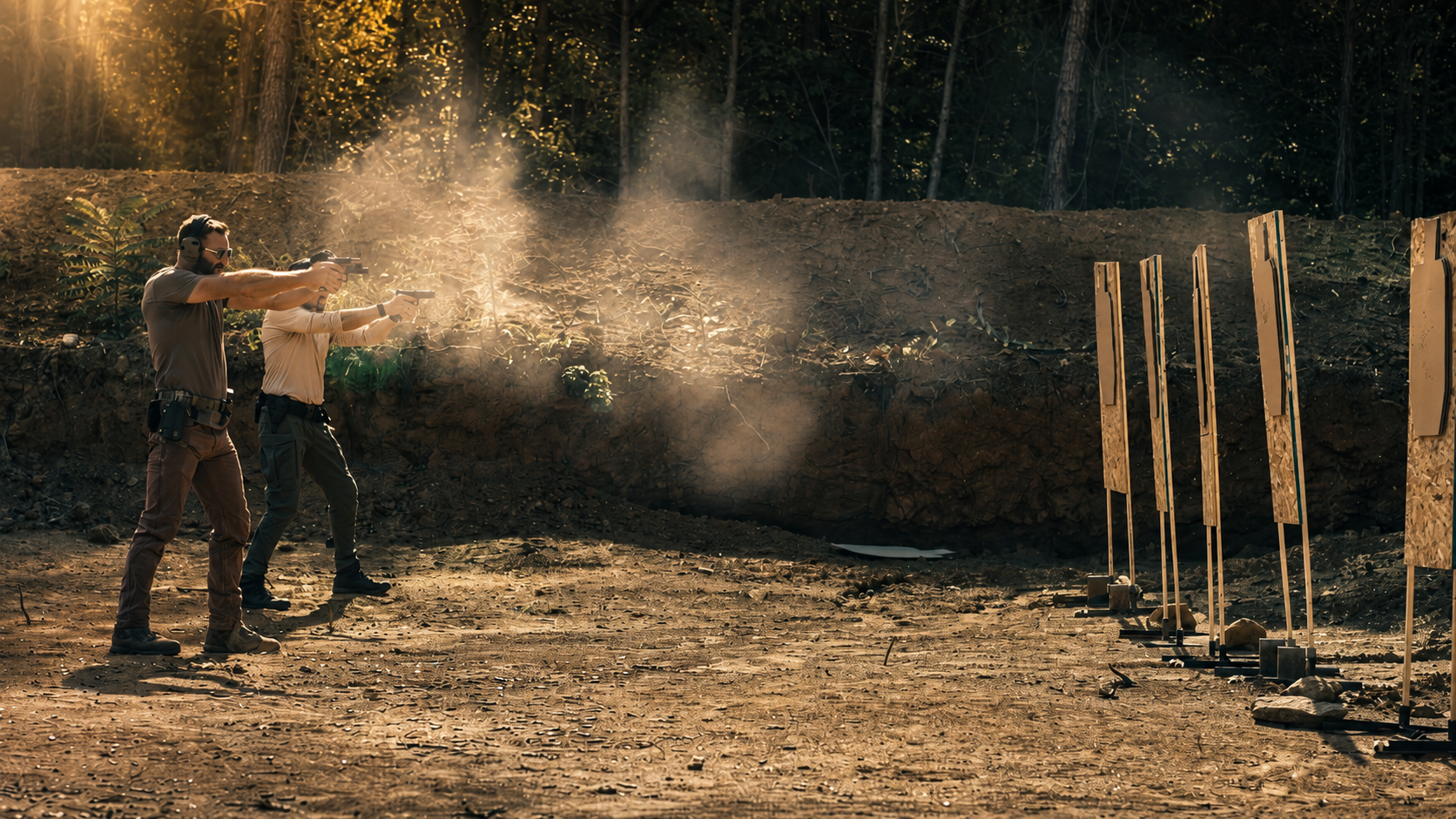
The most common question we get before a class is some version of: Am I good enough for this? New shooters worry they will be out of their depth. Experienced shooters worry they will be bored. Both questions come from the same assumption — that a firearms course is pitched at a fixed skill level, and your job is to find the one that matches yours. It is a reasonable assumption. It is also the wrong frame, and at Black Watch it does not apply.
Every skill course we teach — Core Skills, Dynamic Performance, and Defensive Application — is open to all levels, beginner to advanced. Not as a marketing convenience, but because the training is engineered to scale challenge to the shooter standing in front of it. The question is not whether you are advanced enough. The question is whether you have built the foundation the course depends on. Those are very different things, and the difference is the whole point.
Skill Level Is Not a Gate. Prerequisites Are.
Here is the distinction that reorganizes everything. We do not label our courses “intermediate” or “advanced” as if they were skill checkpoints you have to test into. What gates a course is prerequisite course completion on the same platform — nothing else. Core Skills has no prerequisite at all; you can walk in having never fired a pistol. Dynamic Performance asks that you have completed Core Skills on that platform first. Defensive Application asks for Core Skills and Dynamic Performance.
Why structure it that way? Because the thing that actually determines whether you will succeed in a course is not how talented you are — it is whether the foundation that course builds on is already in place. You cannot integrate skills under speed and stress that you have not yet installed cleanly. That is not a judgment about you; it is how motor learning works. So we gate on the foundation, not on a label, and inside each course we let the difficulty find its own level for each shooter.
How One Course Challenges a Beginner and an Expert at Once
This is the part that sounds impossible until you see it on the range. How can the same two days genuinely challenge someone who has never drawn from a holster and someone who shoots competitively? The answer is in how the training is built. Because every course is grounded in motor-learning science and structured around measurable standards, the same drill does different work for different shooters.
For the newer shooter
The drill installs a clean motor program from scratch. There are no bad habits to fight, which is often an advantage — a beginner built correctly from the first repetition can progress faster than a veteran who has spent years grooving a flinch. The feedback is specific, the pace is controlled, and the standard at the end gives a real, measured baseline to build from.
For the experienced shooter
The same drill becomes a diagnostic. Tighter par times, smaller targets, added movement, and instructor-designed problem sets expose the cracks that unstructured volume has been hiding. Most experienced shooters discover that fundamentals they assumed were solid have quietly drifted — and getting specific, measured feedback on what their grip or trigger is actually doing is exactly what they have been missing. The challenge does not come from the course being “advanced.” It comes from the standard being honest.
The challenge is not in the label on the course. It is in the standard the course holds you to — and the standard does not care how long you have been shooting.
Why We Refuse the Skill-Label Model
The conventional “beginner / intermediate / advanced” ladder has two failure modes, and we have watched both play out on other ranges. The first: it turns people away who would thrive. A capable new shooter gets told they are not ready for the course that would actually serve them, and they stall in beginner purgatory. The second: it lets people skip the foundation. An experienced shooter self-identifies as “advanced,” jumps straight to the flashy material, and builds dynamic skills on top of fundamentals that were never clean — which is exactly how you cement bad habits at speed.
Gating on prerequisites instead of self-assessed skill closes both gaps. Nobody capable gets turned away from the foundation. Nobody skips it either. Everyone enters at Core Skills, builds on the same clean baseline, and progresses through the same honest standards. The result is a student body that is genuinely prepared for each tier, rather than a room sorted by how people rate themselves.
So Where Should You Start?
For almost everyone, the answer is the same: Core Skills. If you are new, it is your foundation. If you are experienced, it is your tune-up, your diagnostic, and your entry into a progression built on measured standards rather than borrowed ones. It is also the prerequisite for everything that follows, so starting anywhere else is not really an option — and that is by design. There is no shortcut around a foundation, and you would not want one.
If you genuinely have substantial training behind you, we do assess equivalency for the later tiers on a case-by-case basis — but the default, and the honest recommendation, is to start at the foundation and let the standards show you where you actually are. Most experienced shooters who do this tell us the same thing afterward: they learned more about their own shooting in two foundational days than in years of higher-speed work built on a cracked base.
Stop asking whether you are advanced enough. Ask whether you have built the foundation. If the answer is “not yet,” you already know where to start.
What “Assessed Equivalency” Actually Means
We mentioned that the later tiers can be entered by assessed equivalency rather than by completing our Core Skills course specifically. It is worth being precise about what that does and does not mean, because it is not a loophole. Equivalency is not a matter of telling us about your résumé, your gear, or the schools you have attended. It is a matter of demonstrating, on the range, that the foundation a course depends on is genuinely in place — that your mechanics run automatically and hold up to the standard the next tier assumes.
In practice, most shooters find it is faster and more valuable to simply start at Core Skills than to seek equivalency around it. The foundation course is not a tax you pay; it is where you get measured feedback on what your fundamentals are actually doing, which even highly experienced shooters rarely receive. Equivalency exists for genuine cases, but it is assessed honestly and on the gun — never assumed. The standard is the gatekeeper, not the paperwork.
Why This Is Better for the Room
There is a quieter benefit to gating on prerequisites instead of skill labels, and it shows up in the training environment itself. When everyone in a course has built on the same clean foundation, the room moves together. The instructor is not splitting attention between a few people who are lost and a few who are coasting, because nobody slipped in over their head and nobody bought their way past the basics. The drills can be pitched at the standard, the feedback can be specific, and the pace can climb without leaving anyone behind or boring anyone in front.
That coherence is hard to manufacture with a self-sorting skill ladder, where “intermediate” means ten different things to ten different people. It is much easier to guarantee when the entry requirement is a foundation that was actually built and measured. The result is a better day for every shooter in the bay — the nervous beginner and the seasoned competitor alike — because the standard, not the self-assessment, set the level.
A Word to the Nervous First-Timer
If you have never taken a formal class and the idea of showing up makes you anxious, read this part carefully: you are exactly who Core Skills is built for, and you are at an advantage you do not yet appreciate. You have no bad habits to unlearn. Every repetition you make can be built correctly the first time, which means a complete beginner who commits to the process often progresses faster than a veteran who has spent years grooving mistakes at speed. The blank page is not a liability here. It is the cleanest possible place to start.
You will not be thrown into anything you are not ready for, because the course begins with a safe gun-handling briefing and builds from the very first principle. The room will not be full of people waiting for you to fail; it will be full of people working on their own fundamentals under the same honest standard. The only thing we ask you to bring is a willingness to be coached. Do that, and two days from now you will leave shooting faster, more accurately, and with a measured baseline you can build on for years. Nervousness is normal. It is not a reason to wait.
Every course is built to challenge beginner to advanced. We meet you where you are — and the standard pushes you from there.
Not sure which class fits? Browse the course path, see what is open on the training calendar, or just ask us at [email protected] — we will point you to the right starting line.
Leave a Reply