

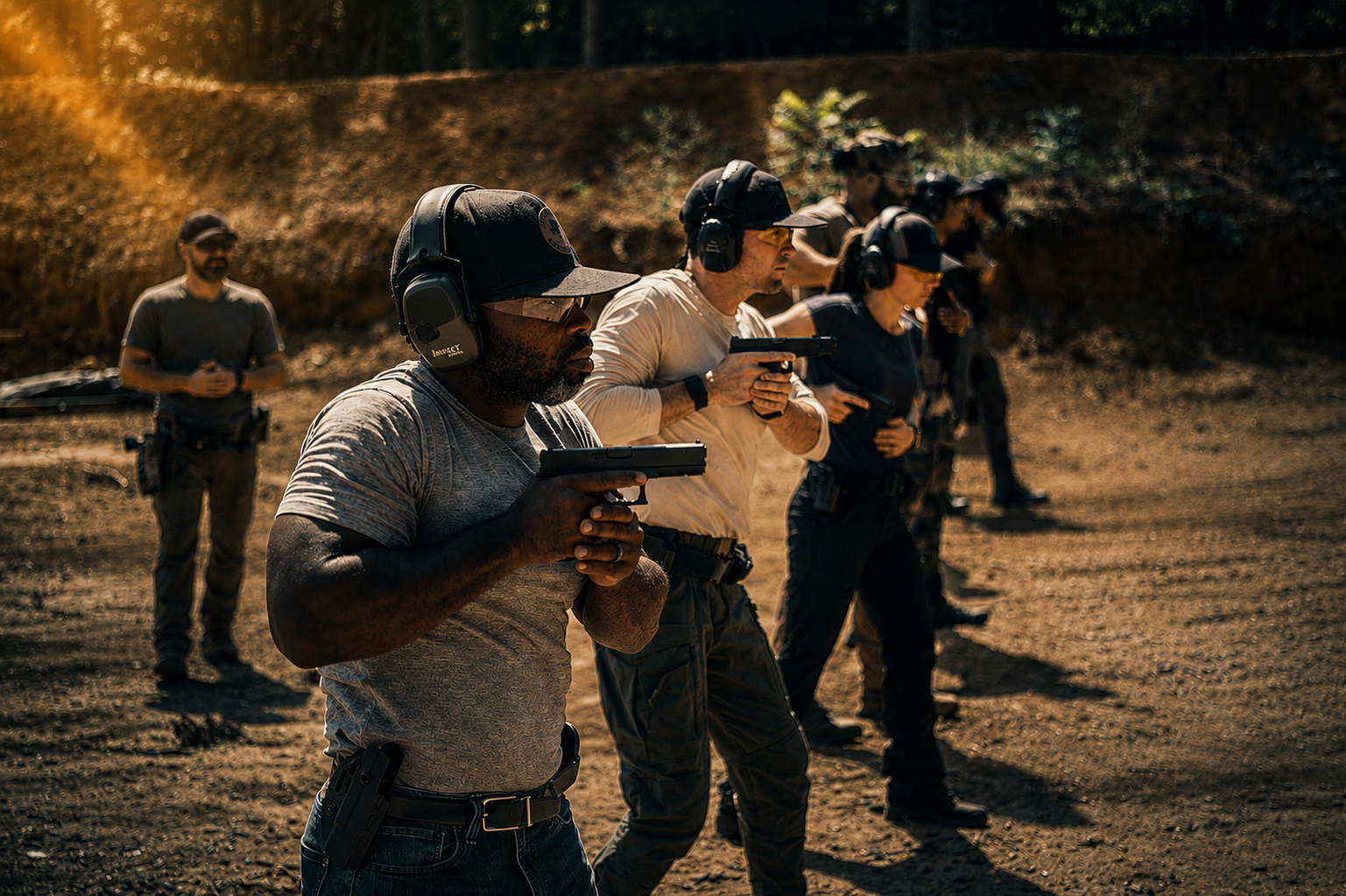
Most firearms instruction is sold as a menu of disconnected one-off classes. You take a defensive pistol course here, a carbine course there, a low-light night somewhere else, and you hope the pieces add up to a complete shooter. Usually they do not. Skills built out of order, without a foundation underneath them, tend to sit as isolated party tricks rather than integrating into genuine capability.
Black Watch is built differently. We teach a path — a deliberate four-step progression where each tier counts toward the next and every course is engineered to stack onto a foundation already in place. The path is the same whether you train the pistol or the carbine, and it runs from your very first round to a recognized standard of mastery. Here is how it works, and why the order matters.
01 – Core Skills – The Foundation
Everything starts here. Core Skills is the foundational tier, grounded in motor-learning science, built to install the technically correct mechanics that underpin every practical shooting discipline. Grip, stance, sight alignment and sight picture, trigger mechanics, the draw and presentation, reloads, and malfunction clearance — drilled through deliberate, closed-skill repetition until they run without conscious thought.
This is the tier people are tempted to skip, and skipping it is the single most common reason shooters plateau. Real confidence comes from fundamentals you can repeat under pressure, not from luck or from borrowed gear. Whether you have never fired a pistol or you have shot for years on bad habits, Core Skills gives you a clean, measurable baseline — and it ends with a timed standard so you know exactly where you stand. There is no prerequisite. You start here.
- Tier: Foundation
- Format: 2 days · Pistol or Carbine
- Prerequisite: None — this is the entry point
- You leave with: automatic mechanics and a measured baseline to build from
02 – Dynamic Performance – Integration Under Stress
Static accuracy is the floor, not the ceiling. Dynamic Performance takes a shooter who already owns their fundamentals and integrates them into fast, fluid, decision-heavy problems — multi-threat engagement, shooting on the move in every direction, transitions, cover and movement, recoil control at speed. Every drill is engineered to transfer, using par times, performance metrics, and instructor-designed problem sets that apply measured stress.
This is where shooting starts to look like performance rather than marksmanship. The two days build from closed-skill refinement on day one to open-skill, scenario-driven application on day two — the kind of dynamic problems that simulate real situations and demand fast, sound decisions under the timer. You leave faster, more adaptable, and able to diagnose your own breakdowns. The prerequisite is Core Skills on the same platform, because you cannot add speed and movement to mechanics you have not yet built.
- Tier: Advanced
- Format: 2 days · Pistol or Carbine
- Prerequisite: Core Skills (same platform) or assessed equivalency
- You leave with: integrated skills that hold up at speed, on the move, under the clock
03 – Defensive Application – Thinking Before Shooting
Defensive shooting is a thinking problem before it is a shooting problem. Defensive Application takes everything you have built and applies it in realistic, high-pressure contexts: defensive mindset and a use-of-force framework, threat recognition and situational awareness, drawing from concealment, close-quarters work and retention, positional and low-light shooting, and shoot / no-shoot decision-making under stress.
The emphasis here is judgment. You train the full sequence — read the situation, recognize the threat, draw, move, and deliver accurate hits — then debrief against measurable benchmarks. It is built on the same motor-learning foundation so sound mechanics hold up while you make fast, lawful decisions. The prerequisite is Core Skills and Dynamic Performance on the same platform, because realistic defensive application only means something once the mechanics and the dynamic skills are already in place.
- Tier: Defensive
- Format: 2 days · Pistol or Carbine
- Prerequisite: Core Skills & Dynamic Performance (same platform) or assessed equivalency
- You leave with: the ability to apply skill and judgment together under realistic pressure
04 – Artifex Capstone – The Mastery Standard
The path culminates in the Artifex Capstone. This is not another course in the usual sense; it is where the craft is proven. To earn it, you demonstrate a high standard across Core Skills, Dynamic Performance, and Defensive Application on a single platform — pistol or carbine — under the eyes of a review board. Meet the standard and you earn the Black Watch Artifex Patch and Coin for that platform. Meet it on both pistol and carbine and you earn both, each its own mark.
Artifex is Latin for craftsman — a master of an art, the root beneath the word artisan. The name is deliberate. The Capstone marks a standard, not a certificate; an Artifex is not simply someone who finished the courses, but a shooter who has made the skill their own and can prove it under pressure. We will have much more to say about what that standard demands in a dedicated piece — but it anchors the entire path, and it is the reason every tier beneath it is held to honest measurement.
- Tier: Capstone
- Format: Per platform · Pistol or Carbine
- Earned by: a high standard across all three courses on that platform, with review-board sign-off
- You earn: the Artifex Patch & Coin — per platform; earn both for both
Why the Order Is the Point
The progression is not bureaucracy and it is not an upsell. The gating between tiers is built on one thing: prerequisite course completion on the same platform — not your self-assessed skill level. That distinction matters. We do not lock courses behind a label like “advanced” and decide you are not ready. We require that the foundation a course depends on is actually in place, because the science is clear that skills built out of order do not hold. Dynamic problem-solving rests on automatic mechanics. Defensive judgment rests on dynamic capability. Mastery rests on all three.
Build it in order and each step makes the next one possible. That is what turns a collection of classes into a complete shooter.
How Long Does the Path Take?
There is no fixed clock, and we will not pretend there is. Every skill course on the path is two days, so the raw classroom time is modest — but the path is not really measured in days. It is measured in the work you put in between courses. The shooter who treats Core Skills as a foundation to practice and refine before moving up will get more out of Dynamic Performance than the shooter who rushes from one class to the next without consolidating anything in between.
Because seats, tuition, and round counts are announced per class on the live training calendar rather than fixed in advance, you build your path around your schedule and the calendar, not around a rigid cohort. Some shooters move through a platform in a single busy season; others take a year or more, training deliberately and earning the standard when they are genuinely ready for it. Both are doing it right. The path rewards patience and punishes shortcuts, which is exactly how a craft should behave.
A Note on Instructor Development
There is a fifth element that sits deliberately off the path: Instructor Development. It is not a rung in the progression and it is not for everyone — it exists, by request, for shooters who want to learn to teach the method rather than simply perform it. We mention it here only so the map is complete. The four-step path is the spine of the program; Instructor Development is a separate branch for those called to coach. If that is you, reach out and we will talk about what it involves.
Everything Counts Toward the Capstone
One detail ties the whole progression together: each of the three skill courses explicitly counts toward the Artifex Capstone on its platform. Core Skills, Dynamic Performance, and Defensive Application are not just sequential classes — they are the three pillars the mastery standard is assembled from. That is why the standards beneath the Capstone are held honestly at every tier. You are never just “taking a class.” You are laying a measured stone in a structure that culminates in a recognized mark, earned in front of a review board, on the pistol or the carbine.
Built to Be Repeated, Not Just Completed
One more thing the path gets right that a menu of one-off classes cannot: a Black Watch course is built to be repeated, not merely checked off. Because every course is structured around measurable standards rather than a one-time experience, coming back to Core Skills a year into your training is not redundant — it is one of the most valuable things you can do. You return with more capability, the drills expose finer cracks, and the standard you are measured against does not soften just because you have been before.
This is how serious practitioners actually improve, and it is why we do not treat the progression as a one-way escalator you ride once and step off. The tiers are a structure to move through and then revisit with fresh eyes. A shooter chasing the Artifex standard will often cycle back through the foundation deliberately, sharpening the mechanics the whole structure rests on. The path is not a checklist. It is a place to keep doing the work.
Four steps, one standard. Every course meets you where you are — beginner to advanced — and pushes real development at every level.
See the full progression on the programs page, find the next open class on the training calendar, or ask us where to start at [email protected].
Leave a Reply